Smart garage door controllers and app control
A controller that opens the door from your phone adds an account, an app and a network connection to a machine that can hurt someone. The safety rule still applies, and the sensors must still work.
By SavvyHearth Editorial Team Updated 6 min read
In short
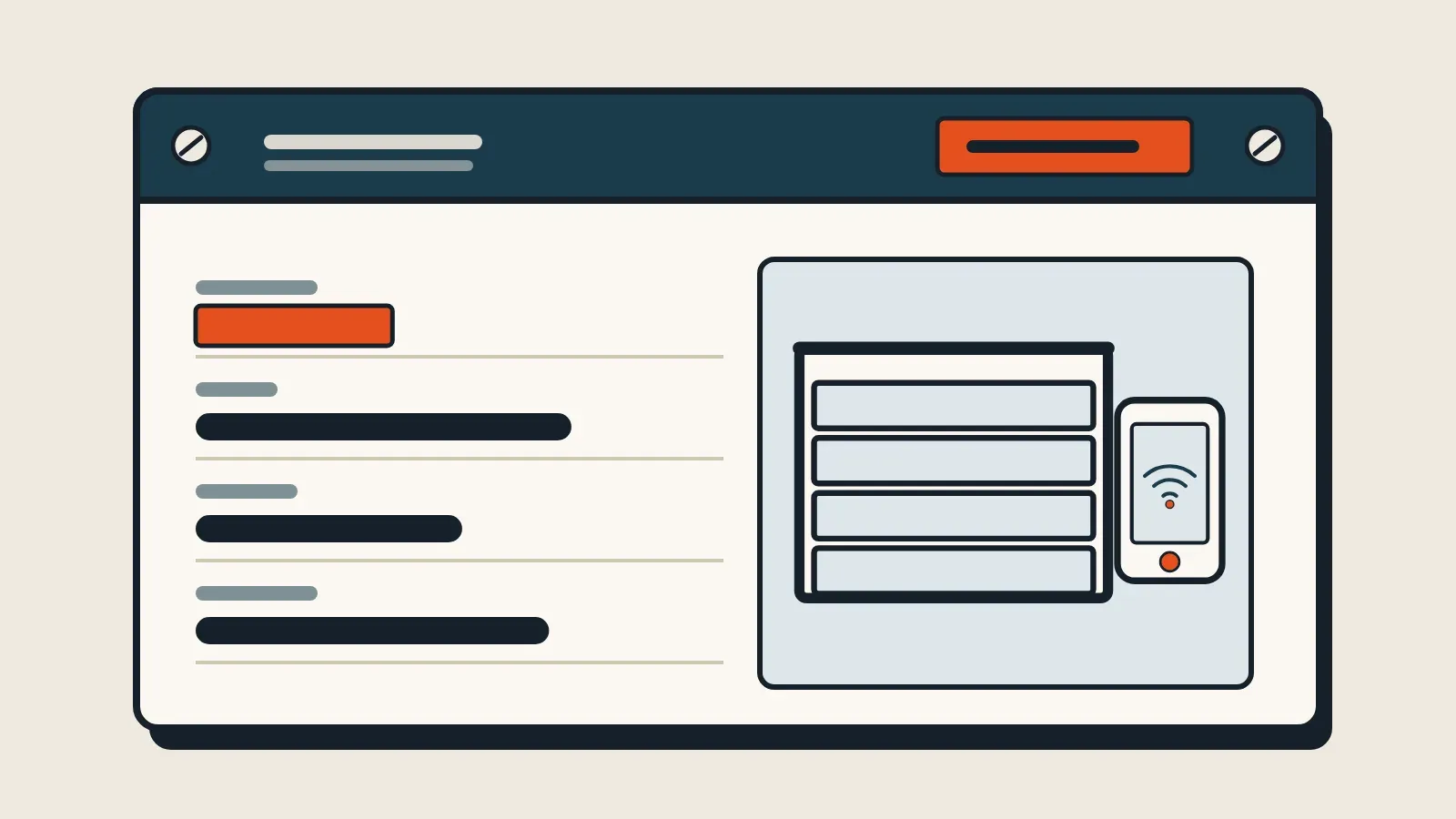
A retrofit controller usually connects to the two terminals where the opener's wall control attaches and acts like a press of that button. A built-in Wi-Fi opener has the same function inside. The CPSC's rule on unattended operation (16 CFR 1211.14) says an operator must sound an audible alarm and flash a light for at least 5 seconds before an unattended closing movement, and suspend unattended operation after two entrapment stops. A controller must not bypass the photo-eyes or the reversal. Matter 1.5, released in November 2025, includes garage doors among its closure devices.
Two kinds of smart control
A retrofit controller is a small box with a Wi-Fi radio that you wire to an opener you already own. A smart opener has the Wi-Fi built in. Either way you use an app to open or close the door, see its state and sometimes set alerts or schedules.
Tailwind's support article describes how a retrofit unit connects. It attaches to the two terminals where the wall control's wires meet the opener, using what the article calls “dry contact” control, which closes a circuit between two terminals. The article also says that with dry contact control each door needs a door sensor, since the unit otherwise has no way to tell whether the door is open or closed. It warns not to touch the plug-in connector on some openers. Match the terminals to your opener's manual, and read the maker's compatibility list before you buy.
The federal rule on unattended operation
16 CFR 1211.14, titled “Unattended operation requirements,” is part of the CPSC's garage door operator standard. As the section reads, the operator has to give both an audible and a visual alarm for at least 5 seconds before any unattended closing movement. The sound has to be heard inside the garage and fall within 700 to 3400 Hz at 45 dB or more at 10 feet. The light has to flash at least once a second. Pressing a user control, such as a wireless remote, during that warning prevents the pending movement.
The section also says that if an entrapment protection device stops or reverses the door twice, unattended operation is suspended until a new input comes from a user control other than the unattended activation device. Genie's safety page describes this as a lockout that you reset with a local control near the door. It also says unattended operation is allowed only for sectional and horizontally sliding doors, and not for one-piece overhead or swing-type doors. That is the manufacturer's statement, so check your opener's manual.
Under 16 CFR 1211.14, a control accessory that only sends a momentary signal is considered to comply with the requirement not to interfere with the opener's entrapment protection. Whether a particular controller falls under that wording, and how it relates to the unattended-operation alarm, is a question for the maker, so ask before you buy.
A controller must not defeat the sensors
- Photo-eyes stay connected. Genie warns against adding external devices to older operators that do not have photo-eye entrapment protection. See the safety page for the monthly test.
- No jumpers or bypasses. Do not wire across the sensor terminals to silence a fault. A fault means the sensors are not seeing each other, and the door should not close normally.
- Ask for the standard. Genie says not all third-party devices and apps are certified, and advises confirming with the manufacturer that an external device is UL 325 certified. Look for the statement in the controller's manual or the maker's listing.
- Auto-close is unattended closing. A feature that shuts the door by itself or from a distance falls under the warning and lockout rule above. Ask the maker how the product meets it.
- Keep the warning label. Genie says a label near the local controls is required, and to keep it in place.
After installing any controller, run the floor-object reversal test and the photo-eye test again, and test the app's close command with you standing in the garage.
Accounts, privacy and updates
A cloud-connected controller is a small computer on your network, tied to an account. The sources listed on this page do not describe a regulatory label that tells you what such a product collects, so the questions are yours to ask the maker before you buy.
- Who owns the account, and what happens to your access if the company changes or ends the app?
- Does the app keep a log of when the door opened and closed, who did it, and for how long?
- Can you give a guest access for a set time, and can you remove it?
- Does the product keep working locally if the internet is down, or only through the maker's servers?
- How are firmware updates delivered, and for how long does the maker say it will provide them?
- What does the door do if the phone is lost? Use a strong, unique password and turn on any two-step sign-in.
The smart home privacy and updates page covers account hygiene and what to read in a privacy policy. Programs that let a delivery driver or a service person open your door are set up by the program's own terms, so read them for who gets access, and how you can end it.
Matter and works-with labels
The Connectivity Standards Alliance announced Matter 1.5 on November 20, 2025. It says the release introduces a unified approach to closures that covers window shades, drapes, awnings, gates and garage doors. Whether a given controller supports it depends on the product and its firmware, so look for the Matter certification mark on the box or the maker's page, and note that a “works with” label for one assistant is not the same as certification. The mark decoder explains the difference.
Matter does not change the safety rule. A garage door still needs its sensors, its reversal and, for unattended closing, its warning. A smart-home routine that closes the door when you leave is unattended operation too.
Questions people ask
Can I add a smart controller to any garage door opener?
Many retrofit controllers connect to the terminals for the wall control, but compatibility varies. Tailwind's support article lists the wiring for specific opener brands and says each door needs a door sensor when it uses dry contact control. Check the controller maker's compatibility list for your opener model.
Does a smart controller bypass the safety sensors?
It should not. The photo-eyes and the auto-reverse belong to the opener. Federal rule 16 CFR 1211.14 adds an audible and visual warning of at least 5 seconds before an unattended close and a lockout after two entrapment stops. Ask the maker how a given controller relates to that warning.
Does a smart garage door controller support Matter?
Some products may. The Connectivity Standards Alliance says Matter 1.5, announced November 20, 2025, covers garage doors among closures. Check the product's certification mark, and do not rely on a works-with label.
Is it safe to close the door from my phone when I am away?
Unattended closing is the case the rule's warning covers: an audible alarm and a flashing light in the garage before the door moves. Genie notes that you cannot see the area around the door when you are away. Close the door remotely only when you know the way is clear, and test the sensors monthly.
Sources
- Cornell Legal Information Institute: 16 CFR 1211.14, Unattended operation requirements
- Connectivity Standards Alliance: Matter 1.5 introduces cameras, closures and energy management (November 20, 2025)
- Genie: safety tips when upgrading to a smart garage door opener, unattended operation
- Tailwind support: connecting to openers with dry contact control
Rules and figures checked on November 20, 2026. The text of 16 CFR 1211.14 was read on the Cornell Legal Information Institute page, so check the current eCFR text. A CPSC direct final rule (2026-22213) that updates part 1211 to UL 325:2025 is pending, scheduled for December 29, 2026 unless withdrawn, and the section may change. Statements on door types and certification come from Genie's own page, and the wiring from Tailwind's, so confirm both with the maker of the product you buy.
Read next
-
Smart home
Smart home privacy, accounts and updates
Sign-in, router settings, updates, end of support and the Cyber Trust Mark status, as of November 2026.
-
Garage
Garage door safety: sensors, auto-reverse and UL 325
Federal opener rules, a monthly reversal test, and the battery-backup update set for December 2026.
-
Garage
Garage door openers: chain, belt, screw and direct drive
Drive types, what horsepower numbers mean, and battery backup under the 2026 rule update.